A Havc Filter is more than a disposable rectangle behind a return-air grille. It is a key part of an HVAC system’s air-cleaning and airflow balance. The correct filter can capture dust, pollen, and some airborne particles before they circulate through rooms. The wrong filter may restrict airflow, increase energy use, and strain the blower motor.
The U.S. Environmental Protection Agency reports that indoor pollutant levels can be two to five times higher than outdoor levels. In some cases, concentrations may reach 100 times higher. That statistic makes filtration important, but it does not make every high-rated filter suitable. ASHRAE Standard 52.2 evaluates filter performance through Minimum Efficiency Reporting Values, or MERV ratings. A higher MERV rating generally captures smaller particles, yet system compatibility remains essential.
Technicians often find heavily loaded filters in homes with pets, renovations, or nearby road traffic. The filter may look acceptable from the room side while its pleats hold a thick gray layer. Small details matter. Check the size, airflow arrow, replacement interval, and equipment manual. The U.S. Department of Energy also emphasizes that airflow affects heating and cooling performance, not just comfort.
There is no universal “best” filter. That assumption is incomplete. A MERV 8 filter may suit one older system, while a properly designed system may support MERV 11 or MERV 13. The best choice balances particle capture, pressure drop, indoor conditions, and manufacturer limits. This guide examines filter types, ratings, materials, maintenance, and practical selection methods. Evidence helps, but real buildings can still surprise you.
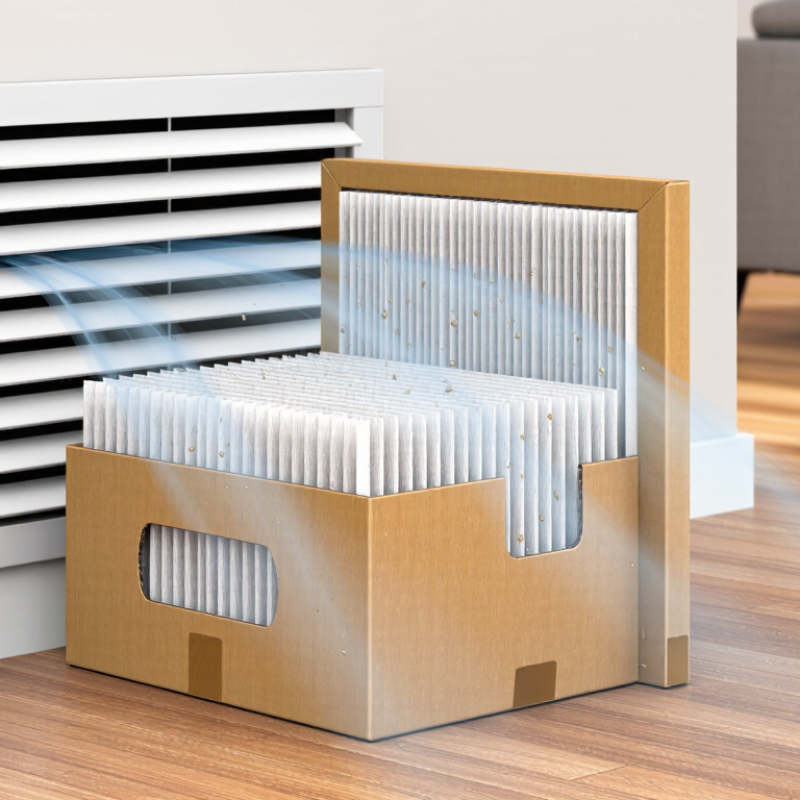
What Is an HVAC Filter and Which Type Is Best?
An HVAC filter is a removable barrier inside a heating or cooling system. It captures dust, fibers, pollen, and some smaller airborne particles. Under ASHRAE Standard 52.2, filters receive MERV ratings through particle-size efficiency testing. The test examines particles from roughly 0.3 to 10 micrometers. MERV 8 and MERV 13 filters perform differently across these size ranges. A higher number does not automatically mean better system performance.
Airflow matters just as much as filtration. A dense filter can increase pressure drop across the equipment. The blower then works harder, while rooms may receive less conditioned air. During filter inspections, I have found filters that looked clean but still restricted airflow. Dust on the upstream surface was not always obvious. A pressure reading often revealed the problem earlier. This is where practical judgment matters.
The suitable filter depends on the equipment, duct design, and indoor air goals. Check the equipment manual before selecting a higher MERV filter. Measure pressure drop with a manometer when possible. Keep the filter seated tightly, because air can bypass loose edges. MERV 13 may offer stronger particle capture, but only when the system can support it. I sometimes favor a lower-rated filter for an older system with weak airflow. That choice deserves regular review, not blind confidence.
Under ANSI/ASHRAE Standard 52.2, MERV ratings are based on a filter’s ability to remove particles in three size ranges: 0.30–1.0, 1.0–3.0, and 3.0–10.0 micrometers. Higher MERV groups are evaluated down to smaller particle sizes, but the best choice must also consider system airflow, pressure drop, and the equipment manufacturer’s requirements.
Data basis: ASHRAE Standard 52.2 MERV particle-size test bands. Particle-size values represent the lower limit of the smallest evaluated band for each MERV group.
An HVAC filter captures airborne particles before air returns through the system. MERV ratings show performance by particle size, not overall cleanliness. Under ASHRAE 52.2 testing, MERV 8 filters capture at least 70% of particles sized 3–10 microns. Their efficiency drops to about 20%–34% for 1–3 micron particles. Performance below 1 micron remains limited.
MERV 11 improves the middle range, capturing about 65%–79% of 1–3 micron particles. MERV 13 reaches at least 85% in that range and at least 70% for 0.3–1 micron particles. That difference matters for fine dust, smoke, and some respiratory aerosols. Still, ratings come from controlled laboratory testing. Real results depend on fit, airflow, installation, and filter loading. A loose edge can bypass the filter completely.
I once treated the rating as the whole answer. That was a mistake. Higher filtration can increase resistance, especially when the filter becomes visibly dirty. Before choosing MERV 13, check the equipment manual and measure airflow when possible. A properly fitted MERV 8 may outperform a poorly sealed MERV 13. The best choice balances particle-size efficiency, system capacity, replacement frequency, and indoor conditions. The chart helps, but it is not magic.
An HVAC filter sits in the return-air path and removes particles before air reaches the blower and supply ducts. Filter choices range from basic fiberglass media to high-efficiency pleated filters. “Best” depends on airflow, equipment design, and indoor concerns.
HEPA filtration is measured differently from ordinary residential ratings. Under IEST-RP-CC001.4, a true HEPA filter must capture at least 99.97% of particles measuring 0.3 microns. This size is difficult to capture, making it a demanding test point. The Institute of Environmental Sciences and Technology identifies it as the most penetrating particle size, not the largest particle a filter can remove. That distinction matters.
A HEPA panel can help reduce fine dust, smoke particles, and some biological aerosols. However, it may create substantial pressure drop in a standard furnace. ASHRAE Standard 52.2 explains how HVAC filters receive MERV ratings through controlled particle-efficiency testing. A higher rating is not automatically safer when the blower cannot maintain designed airflow. Poor fit also creates bypass leakage around the filter.
Check the filter slot, gasket seal, and pressure readings. Technicians often find dust trails beside an otherwise clean filter. That is a warning sign.
The practical answer is less dramatic. Use the highest-efficiency filter your system can support, then verify airflow after installation. HEPA performance sounds absolute, but real buildings are imperfect. Door gaps, duct leaks, and delayed replacement can weaken the result. EPA residential air-cleaning guidance also stresses proper sizing, maintenance, and airflow, not filtration claims alone.
Filter selection should begin with indoor air quality, not the highest efficiency number. The U.S. Environmental Protection Agency reports that indoor pollutant levels can be two to five times higher than outdoor levels. In some cases, they may reach 100 times higher. A MERV-rated filter can capture particles, but MERV is not a complete measure of room air cleaning. ASHRAE Standard 52.2 evaluates filter performance under controlled testing conditions.
HVAC compatibility matters just as much. Check the filter’s exact dimensions, airflow direction, and recommended replacement interval. A high-efficiency filter can create excessive resistance in an older blower system. That may reduce airflow, increase noise, and leave rooms unevenly heated or cooled. The U.S. Department of Energy identifies airflow restriction as a factor that can reduce HVAC operating efficiency. Pressure drop data should come from the filter’s performance sheet, not guesswork.
A practical choice balances particle capture and acceptable resistance. Homes with pets, smoke, or seasonal allergies may need higher filtration. Sensitive equipment may require a professional airflow check. Start modestly. Measure the result. My own mistake has been treating a higher rating as automatically better. It is not.
A filter that loads quickly can also change pressure drop before the scheduled replacement date. ASHRAE guidance supports evaluating the complete system, including fan capacity, duct design, and maintenance practices. Open the access panel and inspect the filter monthly, especially during heavy-use seasons.
HVAC filters capture dust, pollen, and other airborne particles before air returns through the system. Their performance depends on both filter media and airflow. ASHRAE Standard 52.2 defines the testing method behind MERV ratings. A higher rating can improve particle removal, but it may also increase resistance. The fan must handle that resistance.
EPA’s Guide to Air Cleaners in the Home recommends MERV 13, or the highest compatible rating. Compatibility comes from manufacturer data, not guesswork. Check the equipment manual for approved dimensions, airflow, and maximum pressure drop. A filter marked 16 by 20 by 1 inch may have different actual measurements. Measure the existing filter, including its frame. Small errors matter.
Install the filter with the airflow arrow facing the equipment. Check it monthly, as EPA guidance advises, especially during wildfire smoke, construction, or heavy pollen. Replace it when visibly loaded or when the manufacturer’s schedule requires replacement. Many homes need replacement every one to three months, but conditions vary. A thicker filter is not automatically better. It may reduce airflow, create noise, or strain the blower. I have seen clean-looking filters used too long because the calendar seemed convenient. That assumption can fail. Record the installation date and inspect the filter under a bright light. Industry guidance helps, but real household conditions still require judgment.
A practical comparison of common HVAC filter types, MERV ratings, sizing requirements, and replacement considerations.
| Filter Type | Typical Rating or Construction | Particle and Air-Quality Performance | Typical HVAC Use | Main Advantages | Important Limitations | Replacement Guidance |
|---|---|---|---|---|---|---|
| Filter Type and Performance | ||||||
| Fiberglass panel | Usually low-efficiency; commonly around MERV 1–4 | Captures larger dust and lint particles but provides limited removal of fine particles, smoke, and many small allergens. | Basic residential systems where low airflow resistance is required and indoor air-quality demands are modest. | Low purchase cost and generally low pressure drop. | Limited filtration performance; does not provide the level of fine-particle control associated with higher MERV filters. | Inspect monthly; replace when visibly loaded or according to the equipment instructions. |
| Pleated synthetic panel | Commonly MERV 5–13; efficiency depends on media depth and design. | Provides substantially better capture of dust, pollen, mold-related particles, and other airborne particles than a flat fiberglass panel. | Most residential forced-air systems, provided the equipment can handle the filter’s pressure drop. | Good balance of filtration area, availability, cost, and airflow when correctly selected. | A higher rating does not automatically mean better system performance; excessive resistance can reduce airflow. | Check monthly during heavy-use periods; many 1-inch filters are replaced about every 1–3 months, subject to loading and manufacturer instructions. |
| Deep-pleated filter | Often MERV 8–13 or higher; commonly 4–6 inches deep. | Offers more media area than a 1-inch filter and can provide improved fine-particle capture with lower resistance at a comparable rating. | Systems designed with a compatible media cabinet or deep-filter housing. | Longer service intervals and potentially lower pressure drop than a similarly rated 1-inch filter. | Cannot be installed safely unless the filter cabinet and equipment are designed for its thickness. | Commonly checked every 3–6 months; actual interval depends on dust load, occupancy, pets, and operating hours. |
| Electrostatic filter | May be passive or powered; performance varies by construction and operating condition. | Uses an electrostatic charge or powered collection process to improve particle capture; performance should be verified from test data. | Compatible systems specifically designed for the filter type or powered unit. | Can provide reusable or enhanced particle collection in an appropriate system. | Washable models must be cleaned thoroughly; performance can change as the charge declines or the collector becomes dirty. | Inspect monthly; clean or replace according to the product’s tested maintenance schedule. |
| HEPA filter | Typically rated to remove at least 99.97% of 0.3-micrometer test particles under the applicable test method. | Very high-efficiency filtration for fine particles, but it usually creates greater airflow resistance than standard HVAC filters. | Dedicated air cleaners or HVAC systems specifically engineered for HEPA pressure drop and airflow requirements. | Excellent particle filtration when installed in a properly designed system. | Usually not a direct replacement for a standard 1-inch residential filter; may restrict airflow, increase energy use, or stress equipment if the system is not designed for it. | Replace based on pressure-drop limits, visual loading, and the equipment or filter manufacturer’s instructions. |
| MERV Selection and Compatibility | ||||||
| MERV 8 | Entry-level pleated option for many homes. | Improves capture of common household dust, pollen, and larger airborne particles compared with low-efficiency panels. | Many standard residential systems, subject to the system’s specified filter size and pressure-drop limits. | Often a practical balance between basic filtration and airflow. | May provide less fine-particle control than MERV 11–13. | Follow the interval on the filter or equipment instructions; inspect more often in dusty conditions. |
| MERV 11 | Intermediate-efficiency pleated option. | Provides improved control of smaller particles than MERV 8, including many allergy-related particles. | Residential systems with adequate blower capacity and acceptable measured or specified pressure drop. | Useful when occupants want more filtration than MERV 8 without moving directly to the highest commonly recommended residential rating. | Not every furnace or air handler can maintain required airflow with this rating, especially in a thin 1-inch filter. | Inspect monthly and replace when loaded or when the specified interval is reached. |
| MERV 13 | Higher-efficiency option commonly recommended when the HVAC system can accommodate it. | Provides stronger removal of fine particles than lower-rated filters; performance still depends on airflow, fit, leakage, and filter design. | Systems verified by the equipment manufacturer or a qualified technician to support the filter’s pressure drop. | Consistent with EPA guidance to use MERV 13 or the highest rating the system can accommodate, when feasible. | May reduce airflow if the system, filter thickness, or blower is not suitable; the rating alone does not guarantee room-level air cleaning. | Inspect at least monthly after installation and use the interval supported by the manufacturer’s data. |
| Highest compatible rating | Selected from equipment documentation, tested pressure-drop data, and the available filter housing. | The best choice is the highest-performing filter that maintains adequate airflow and does not exceed the system’s design limits. | Any system where compatibility has been confirmed rather than assumed from the MERV number alone. | Balances filtration goals with safe equipment operation and occupant comfort. | Filter efficiency, pressure drop, airflow, system leakage, and installation quality must be considered together. | Recheck after installation and replace when loaded, damaged, bypassed, or outside the recommended service interval. |
| Sizing, Installation, and Replacement Data | ||||||
| Nominal filter size | Rounded label dimensions, such as 16 × 20 × 1 inches. | Used for ordering and identifying the intended filter category; it may not equal the filter’s measured dimensions. | All systems using replaceable panel or media filters. | Quickly identifies the replacement size. | Nominal sizes and actual dimensions vary by construction and manufacturer; do not force an oversized or undersized filter into the slot. | Record the size printed on the existing filter, then verify the slot and the actual replacement dimensions. |
| Actual filter dimensions | Measured length × width × thickness; commonly slightly different from the nominal label. | Determines whether the filter seals correctly and slides fully into the housing. | Required for accurate replacement and for systems with tight filter cabinets. | Reduces bypass air around the filter. | An incorrect thickness or footprint can cause air leakage, noise, restricted airflow, or difficult removal. | Measure the existing filter and the filter opening when documentation is unavailable. |
| Filter thickness | Common residential depths include approximately 1, 2, 4, and 5 inches. | Greater depth generally allows more filter media area, but the system must be designed for that depth. | Determined by the filter cabinet, rails, door clearance, and equipment specifications. | Deep filters can support longer service intervals and lower resistance at a comparable efficiency. | A deeper filter is not interchangeable with a thinner filter unless the housing is designed for it. | Never substitute a different thickness without confirming cabinet fit and pressure-drop compatibility. |
| Airflow direction | Filter arrows should point toward the blower or air handler. | Correct orientation helps the filter perform as designed and prevents structural stress on some filter media. | Return-air filter slots and central air-handler cabinets. | Simple installation check with no special tools. | Incorrect orientation can reduce performance or damage the filter in certain applications. | Check the arrow every time the filter is installed. |
| Replacement timing | Time-based schedules are only starting points; loading is the controlling condition. | Dirty filters increase resistance and can reduce airflow, comfort, and equipment efficiency. | All forced-air HVAC systems with replaceable filters. | Regular inspection helps identify unusual dust loads, moisture, or bypass leakage. | Pets, construction, smoke, high occupancy, continuous fan operation, and poor sealing can shorten service life. | Inspect monthly; replace when visibly dirty, damaged, wet, deformed, or when the manufacturer’s pressure-drop or time limit is reached. |
| Filter fit and bypass control | Filter should sit flat with no substantial gaps around its perimeter. | Air that bypasses the filter is not cleaned, regardless of the printed efficiency rating. | All filter racks, grilles, and media cabinets. | Improves the real-world value of the selected filter rating. | Improvised gaps, crushed edges, or an incorrectly seated filter can significantly reduce effective filtration. | Inspect the seal and filter track during every replacement. |
Application note: EPA guidance generally supports using MERV 13, or the highest filter rating the HVAC system can accommodate, when feasible. Always verify the equipment manufacturer’s allowable pressure drop, airflow requirements, filter dimensions, and installation instructions before upgrading. MERV performance is not a substitute for source control, ventilation, or a properly sized portable air cleaner.
It captures airborne particles before air returns through the heating and cooling system. Fit matters.
It captures at least 70% of particles measuring 3–10 microns. Its efficiency falls to about 20%–34% for 1–3 micron particles. Performance below 1 micron remains limited.
MERV 11 captures about 65%–79% of particles measuring 1–3 microns. It offers stronger fine-particle filtration than MERV 8. Not always enough.
MERV 13 captures at least 85% of 1–3 micron particles. It captures at least 70% of particles measuring 0.3–1 micron. This can help reduce fine dust, smoke, and some respiratory aerosols.
No. Higher filtration can increase resistance and reduce airflow. A filter may also become harder to use when visibly dirty. A poorly sealed high-rated filter can underperform.
A true HEPA filter captures at least 99.97% of 0.3-micron particles under controlled testing. The 0.3-micron size is a difficult test point, not the largest removable particle. The result sounds absolute.
No. A HEPA panel may create substantial pressure drop in ordinary equipment. The blower might not maintain designed airflow. Check the equipment manual before installation.
Inspect the filter slot, gasket seal, and airflow after installation. Look for dust trails beside the filter. Those trails suggest bypass leakage. A tight seal matters.
Choose the highest-efficiency filter the system can support safely. Balance particle capture, airflow, filter loading, replacement frequency, and indoor conditions. I once treated the rating as the whole answer. That was a mistake.
A Havc Filter is a key component of a heating, ventilation, and air-conditioning system, designed to remove airborne particles while allowing sufficient airflow. Its performance is commonly evaluated through MERV ratings under ASHRAE 52.2 testing. Filters rated MERV 8, 11, and 13 provide progressively greater efficiency across different particle sizes, although higher filtration can also increase pressure drop and reduce system airflow if the equipment is not compatible. Selection should therefore balance indoor air-quality goals, HVAC capacity, maintenance needs, and energy use.
HEPA filtration offers a much higher level of particle removal, capturing at least 99.97% of particles around 0.3 microns under applicable IEST standards, but it may require specially designed equipment. The correct filter must match the manufacturer’s approved size, airflow requirements, and pressure limits. Regular inspection and replacement, guided by manufacturer instructions and general EPA recommendations, help maintain filtration performance, protect system operation, and support healthier indoor air.

LJF Air FILTER